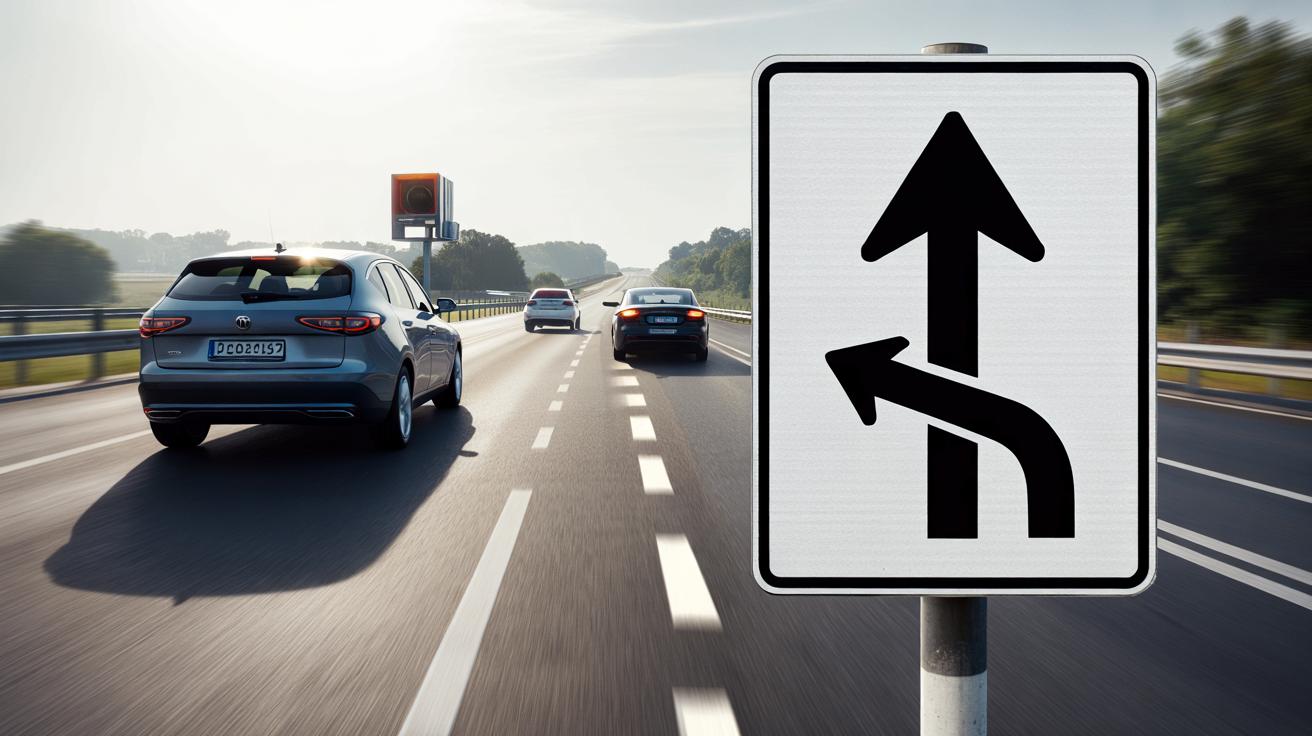
The traffic light had just turned green on a small suburban street when the car in front of Emma suddenly slowed down for no obvious reason. No pedestrian. No speed bump. Just this strange white rectangle with a big black arrow and a thinner line merging into it. She had seen it a hundred times before without really seeing it. The driver ahead hesitated, changed lanes in a panic, and almost clipped a scooter. Horns, insults, raised arms. Then the flash of a roadside camera a few meters later.
On the way home, Emma googled the sign and felt a cold knot in her stomach when she saw the fine attached to it.
She realized something most drivers never admit out loud.
That mysterious sign that quietly drains your wallet
You know the one: a vertical white panel, a thick black arrow going straight, and a slimmer arrow joining it from the side. You pass it every week on bypasses, at highway entries, on those odd semi-urban stretches that look almost like freeways but not quite. Your brain files it into the “yeah yeah, priority something” folder and you keep driving.
Except this sign is anything but vague.
It’s the road sign that means “priority road with lane merging” — and misunderstood, it can turn a perfectly legal maneuver into an expensive violation.
On the ring road around Lyon, traffic police did a small, discreet survey one morning. They stopped 50 drivers just after this sign and asked them what it meant, exactly. Less than a third answered correctly. The others mumbled something about “right of way”, “no overtaking”, or had no idea at all.
Yet just a bit further along, a mobile speed camera and a marked patrol recorded a steady stream of fines. Wrong speed in the converging lane. Dangerous overtaking where the merge begins. Failure to yield to vehicles already established on the priority lane.
All triggered in a zone where this single sign is supposed to organize everyone’s behavior.
This is where the misunderstanding hurts. The sign doesn’t simply say, “you’re on a priority road.” It also quietly tells you: “a second flow of traffic is about to join you, and from this point, the main lane keeps priority.” Drivers who don’t read that nuance start improvising. They accelerate to “beat” the car arriving via the merge. They brake hard, thinking they’re losing priority. They drift across markings at the last second.
Yet the Highway Code is crystal clear: the thick arrow keeps priority, the thin arrow must fit into its rhythm.
Confuse that, and you invite both conflict and fines.
➡️ Forget bleach and ammonia: the ingredient to add to your mop water for perfectly clean floors
➡️ No vinegar, no soap: the magic trick to banish limescale from your electric kettle
➡️ Warning signs are building: what’s brewing in the Pacific signals a harsher new climate phase
➡️ The ingredient you need to add to your mop bucket for floors that stay clean longer
➡️ The simple trick to clean your jewellery easily and make it look new
➡️ Forget the classic bedroom wardrobe, everyone now wants this space‑saving alternative
➡️ Neither chess nor crosswords: the best activity to keep your brain sharp after 60
➡️ The product to use to clean the inside of the toilet like new, without effort and in seconds
How to read it in two seconds and avoid a three-digit fine
There’s a simple way to decode this sign instantly. First, ignore the white rectangle. Focus on the arrows. The thick, straight arrow is you. Your lane continues, you stay the reference, you keep priority. The thin arrow is the others. They’re joining you, and they must adapt.
The moment you see it, do three things, calmly: check your mirrors, glance at your speed, and scan the merging lane ahead. You’re not supposed to slam on the brakes or gun the engine. You’re supposed to hold a stable, predictable trajectory. The clarity of your behavior is what makes the merge safe.
The most common error happens in light traffic, on those days when the road looks almost empty. A driver enters the priority road via the merging lane and, seeing no one, accelerates beyond the posted limit “just for a second” to fall into the flow. A mobile camera placed a few meters after the end of the merge catches them at 15 or 20 km/h over.
Another frequent scene: on a busy commuter route, a car on the main lane sees several vehicles trying to merge and suddenly brakes hard, almost to a standstill, to “be nice”. The driver behind, who trusted the sign and expected the flow to stay regular, has to smash the brakes, and the rear-end collision is almost guaranteed. Empathy on the road is good. Ignoring the code that organizes it is not.
A road safety instructor described it bluntly:
“Most people don’t get fined because they’re reckless. They get fined because they’re guessing. They react to how it ‘feels’ instead of what the sign actually says.”
To stop guessing, it helps to keep a short mental checklist. When you see this panel:
- Identify your role: are you the thick arrow (on the main lane) or the thin arrow (joining)?
- Match your speed to the posted limit before the camera zone, not after it.
- Hold your line: no sudden lane changes in the merge area.
- Use your indicators clearly if you’re the one joining the priority lane.
- Expect the other drivers to be confused and leave a margin of safety.
*This tiny pause in your head is often the difference between a fluid merge and a letter from the traffic authority a few days later.*
The sign we all think we know, but barely talk about
What’s striking with this road sign is how invisible it has become. We crammed its meaning years ago for our driving test, recited it in a hot exam room, then left it in a dusty corner of our memory. On the road, routine took over. Our eyes slide over the rectangle, our brain fills in the blanks, and we trust the “feel” of the flow more than the actual rule.
We’ve all been there, that moment when a sign seems familiar but your body, not your memory, takes the decision.
This also explains why fines connected to this sign feel so unfair. People receive a notice for speeding right after a merging zone and swear they were “just adapting to traffic”. Others get ticketed after a crash because they cut across the thick arrow’s lane, thinking priority was shared. The law doesn’t look at intentions. It looks at markings, signs, and precise locations.
Let’s be honest: nobody really revises the Highway Code every single year.
Yet our everyday driving is built on that fragile knowledge, updated mainly by guesswork and habit.
Sharing this small piece of decoding with friends, teenagers preparing for their license, or older relatives who still drive can quietly change a lot. It’s a modest sign, almost shy on the roadside, yet it crystallizes a whole way of behaving: either I impose myself, or I join respectfully; either I hold my line, or I improvise.
On a busy bypass or a sleepy ring road, this difference is measured in meters, seconds, and sometimes in three-digit fines that land without warning.
Some drivers will shrug and pay. Others will see that little white rectangle differently, the next time it appears at the edge of their windshield.
| Key point | Detail | Value for the reader |
|---|---|---|
| Reading the arrows | Thick arrow = priority lane, thin arrow = merging traffic | Instantly knows who must adapt in the merge |
| Typical violations | Speeding after the sign, dangerous overtaking, failure to yield from merge | Avoids common fines linked to this specific zone |
| Driving attitude | Stable speed, clear trajectory, anticipatory mirrors check | Less stress at merges, safer and smoother journeys |
FAQ:
- What exactly does this sign with two arrows mean?
It indicates a priority road where another lane will merge into yours. The thick arrow shows the lane that keeps priority, while the thin arrow represents the lane that must join and yield.- Can I change lanes right after this sign?
You can change lanes only if road markings allow it and if it doesn’t disrupt the flow on the priority lane. Sudden lane changes in or near the merge area can be considered dangerous driving.- Why are there often speed cameras near this sign?
Authorities place cameras there because drivers tend to speed up or brake abruptly during merges. These behaviors create accidents and recurrent violations, so the area is closely monitored.- Who has priority if I’m the one joining via the thin arrow?
Vehicles already on the main lane, represented by the thick arrow, have priority. You must adapt your speed in the merging lane to fit into a safe gap without forcing others to brake hard.- How can I avoid fines related to this sign?
Slowly read the sign as “I’m thick or thin arrow?”, respect the posted speed before entering the merge, hold a steady line, and anticipate confused drivers around you. These simple habits drastically cut the risk of tickets.