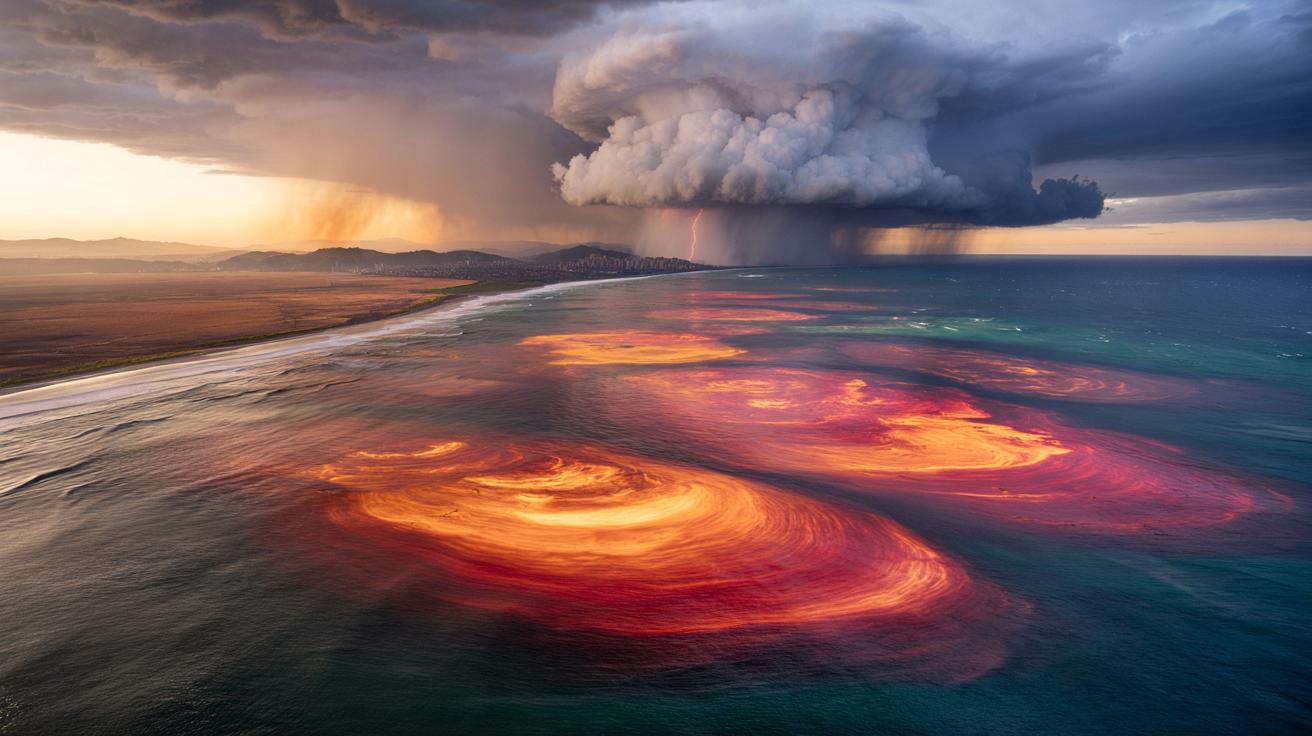
The first time you notice it, it’s almost nothing. A satellite map on your phone, streaked with strange reds blooming across the Pacific. A line in a forecast: “sea surface temperatures significantly above average.” Then a friend in California mentions wildfire smoke in May, earlier than usual. A cousin in the Philippines texts photos of a “once in a decade” storm that somehow now arrives every three years.
You scroll, you shrug, you swipe to the next thing.
But those red swirls in the middle of the world’s biggest ocean are not just colors on a screen. They’re signals, pulsing quietly, that the climate is shifting gears.
And this time, the Pacific is whispering something harsher.
When the ocean starts speaking louder than the weather forecast
Step outside on a day of weird heat and you can feel it instantly. The air is heavier, the light looks slightly off, and the forecast you checked the night before already feels wrong by mid-morning. That’s the kind of subtle chaos building when the Pacific flips into a new mood.
What’s brewing now stretches far beyond “hotter summers” and “stormier winters”. The vast Pacific is warming in patchy, uneven ways, and that patchwork is warping winds, shifting rain belts, and nudging extreme events into new territory.
You don’t need to be a scientist to sense it. You just need to notice how the seasons themselves seem to be losing their script.
Look back at the last few years as a kind of trailer. Wildfires tearing through Canada and turning New York’s sky orange. Record-breaking marine heat waves hitting the North Pacific, cooking kelp forests and starving seabirds. Drought hammering the American Southwest while parts of Asia swing from bone-dry to catastrophic floods in a matter of weeks.
Each of these felt “exceptional” when they hit. Together, they start to look like tiles of a larger pattern.
We’ve all been there, that moment when you realize what you used to call “freak weather” now happens too often to feel freakish. The warning signs are no longer rare blips. They’re stacking up.
➡️ The ingredient you need to add to your mop bucket for floors that stay clean longer
➡️ The product to use to clean the inside of the toilet like new, without effort and in seconds
➡️ Few drivers know the meaning of this road sign – and the costly fine it can trigger
➡️ No vinegar, no soap: the magic trick to banish limescale from your electric kettle
➡️ Forget bleach and ammonia: the ingredient to add to your mop water for perfectly clean floors
➡️ The simple trick to clean your jewellery easily and make it look new
➡️ Neither chess nor crosswords: the best activity to keep your brain sharp after 60
Behind this shift are powerful Pacific patterns with soft names that sound almost harmless: **El Niño**, La Niña, and something quieter but just as influential called the Pacific Decadal Oscillation. Think of them as the ocean’s long, slow heartbeat, changing rhythm every few years or decades.
When the surface of the Pacific warms in certain key zones, it doesn’t just affect surfers in Peru or fishermen near Indonesia. It tugs at the jet stream, shifts where storms form, and alters where heat and moisture travel.
Right now, measurements from buoys, ships, and satellites show the Pacific entering a phase that leans hotter, more variable, and more punishing when it comes to extremes. *The background climate has changed, and these natural cycles are now playing on a different, hotter stage.*
How to read the new climate signals without going numb
One concrete gesture you can adopt is to treat climate data less like abstract charts and more like a neighborhood weather diary gone global. Start small. Notice how often your local news mentions “record-breaking” events. Pay attention to when rain arrives compared with ten years ago, how early heat waves start, or how late the first frost appears.
Then connect those local shifts to what the Pacific is doing. When you hear “El Niño” announced, mentally prepare for a year where heat and heavy rain might come in sharper bursts. When you hear “La Niña”, think about stronger Atlantic hurricanes and deeper droughts in some regions.
You’re not predicting the future. You’re learning to sense the mood of the planet’s biggest ocean, the one quietly steering so much of your daily weather.
A common trap is swinging between two extremes: panic scrolling or total denial. Many people switch off when they hear phrases like “anomalous warming in the central Pacific”. It sounds distant, coded, almost like another language. Then a brutal heat wave arrives, or a so-called “atmospheric river” floods a town, and everyone scrambles to make sense of it.
Let’s be honest: nobody really reads dense climate reports every single day. That doesn’t mean we have to stay in the dark. You can build a simple habit: once a month, glance at a reliable climate dashboard or a reputable weather service and check three things – global ocean temperatures, El Niño/La Niña status, and current drought or flood hotspots.
You’re not trying to be perfect. You’re just refusing to be completely blindsided.
Climate scientist Kim Cobb put it bluntly in a recent interview: “What the Pacific is telling us right now is that extremes we once called rare are lining up to become someone’s new normal.”
- Watch the Pacific patterns
Look up seasonal forecasts mentioning El Niño, La Niña, or “neutral” conditions and note how your region typically responds. - Track your local extremes
Jot down the first heat wave, the strongest storm, or the driest month each year. Patterns emerge faster than you’d expect. - Link smoke, storms, and heat to the ocean
When you see wildfire haze or flash floods on the news, ask: is the Pacific in a warm or cool phase right now? - Talk about it in plain language
Skip the jargon with friends and family. Use simple phrases like “the ocean is running a fever” or “the Pacific is pushing storms our way”. - Plan small, practical buffers
From better blinds for heat to a backup plan for floods, minor adjustments today can blunt tomorrow’s harsher edges.
The harsher phase nobody voted for, but everyone will feel
What’s arriving in the next decade isn’t a single “climate catastrophe day” circled on a calendar. It’s a longer, messier phase where Pacific-driven swings in weather ride on top of long-term warming, amplifying heat, stress, and surprise. Some years will feel oddly mild, almost like a reprieve. Others will stack disasters: a record marine heat wave, then fires, then floods fed by supercharged storms.
This uneven rhythm is what makes it so hard to process. It lulls, then it shocks. Your city might go from water restrictions one year to emergency flood alerts the next, driven partly by how the Pacific rearranges rainfall. Farmers will juggle planting decisions around increasingly unreliable seasons. Coastal communities will see storms chewing away at already rising shorelines.
The Pacific doesn’t care about our schedules, our elections, our sense of “normal”. It runs on physics, not opinion polls. And as its heat builds and its patterns shift, the consequences seep into food prices, insurance bills, mental health, even where people choose to live.
The quiet question hanging over this new phase isn’t just “How bad will it get?” It’s “How honestly are we willing to see what’s already here?”
| Key point | Detail | Value for the reader |
|---|---|---|
| Pacific patterns drive extremes | Shifts like El Niño, La Niña, and long-term ocean warming reshape heatwaves, storms, and droughts worldwide. | Helps explain why local weather feels more chaotic and “off-script”. |
| Signals are already visible | Rising marine heat waves, earlier fires, and shifting rainy seasons match current Pacific conditions. | Makes abstract climate talk feel grounded in lived reality and recent events. |
| Small habits build climate literacy | Checking ocean patterns monthly and noting local extremes creates a personal climate radar. | Gives readers a simple way to stay informed without getting overwhelmed. |
FAQ:
- Question 1What does it actually mean that a “harsher climate phase” is brewing in the Pacific?
- Answer 1It means the Pacific is warming in ways that intensify natural cycles like El Niño and La Niña, which can boost heatwaves, floods, and droughts. These patterns have always existed, but on a hotter planet their impacts land harder and more often.
- Question 2Is this just another El Niño, or something different?
- Answer 2El Niño is part of the story, but not the whole thing. Long-term ocean warming and shifts in broader Pacific patterns are stacking on top of El Niño, making some of its effects more extreme and changing how long the “aftershocks” last.
- Question 3How will this affect everyday life where I live?
- Answer 3It depends on your region, but you’re likely to feel it through more intense heat, weirder rain patterns, stronger storms, or knock-on effects like higher food prices, insurance changes, and disruptions to travel or outdoor work.
- Question 4Is there anything individuals can realistically do about Pacific-driven climate shifts?
- Answer 4You can’t change the ocean by yourself, but you can reduce risk and pressure. That means cutting emissions where you can, backing policies that protect coasts and forests, and preparing your own home and routines for heat, smoke, or floods.
- Question 5How can I stay informed without getting overwhelmed by climate news?
- Answer 5Pick one or two reliable sources, set a fixed time each month to check in, and focus on what’s changing in your region and in the Pacific. Then channel what you learn into one concrete action at home or in your community, rather than doomscrolling.